What it does
Trust accounting, and nothing else
No billing, no matter management, no document assembly, no time recording. One statutory obligation, done to the standard someone is going to audit.
Rule 36
Money comes in
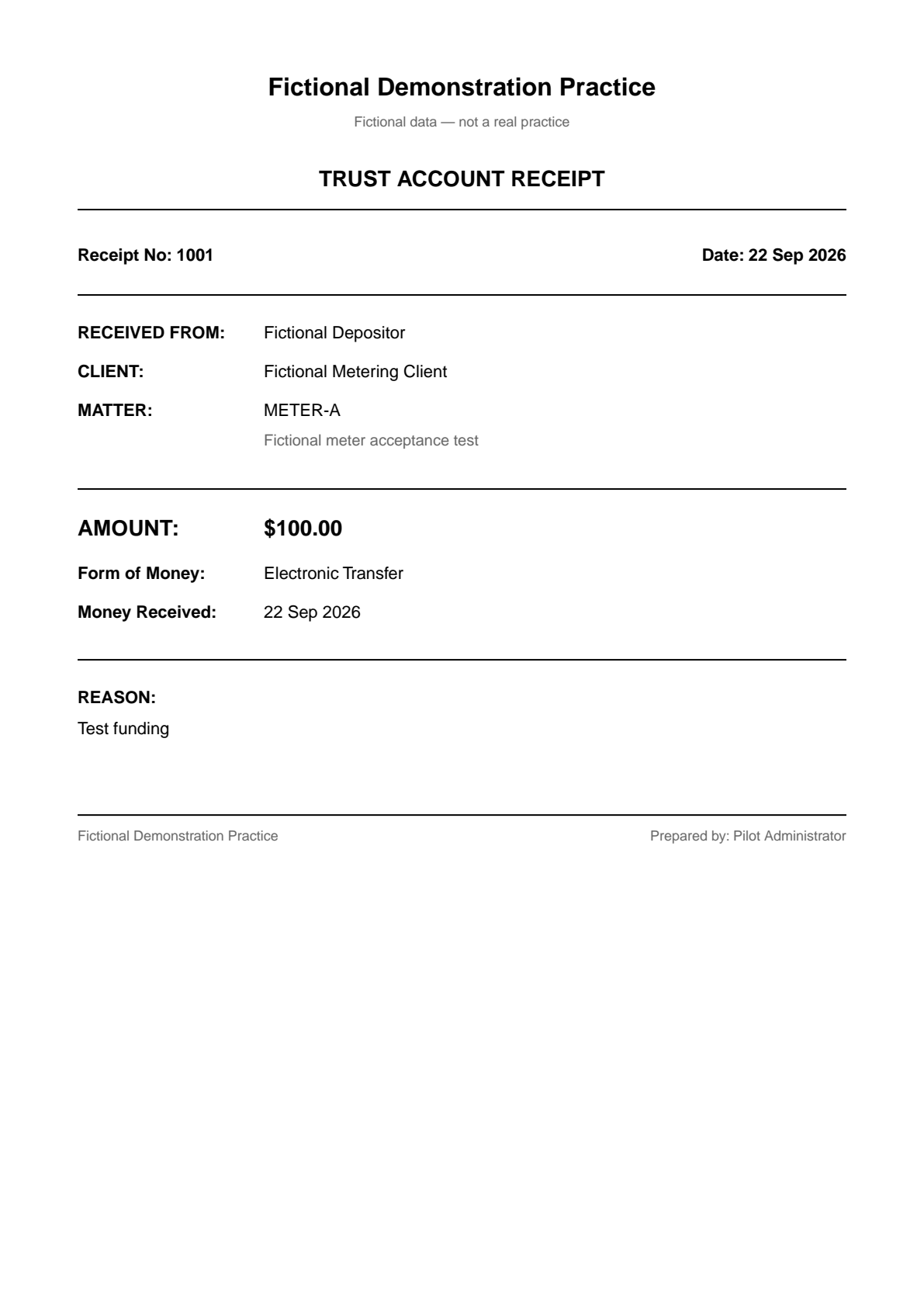
Type the matter reference and the client and matter description fill themselves in. Record what arrived, who it came from, in what form (cash, cheque, electronic transfer, direct debit) and what it was for.
The receipt takes the next number in the sequence. The date the money was received and the date the receipt was issued are separate fields, because Rule 36 treats them as separate facts. The receipt, the ledger movement, the running balance and the cash book entry are written in one database transaction: either all of them exist or none of them does.
Rule 36
Trust receipt
The receipt as it is issued, ready to give to the payer. Fictional practice, invented figures.
Rules 45 and 47
Money goes out
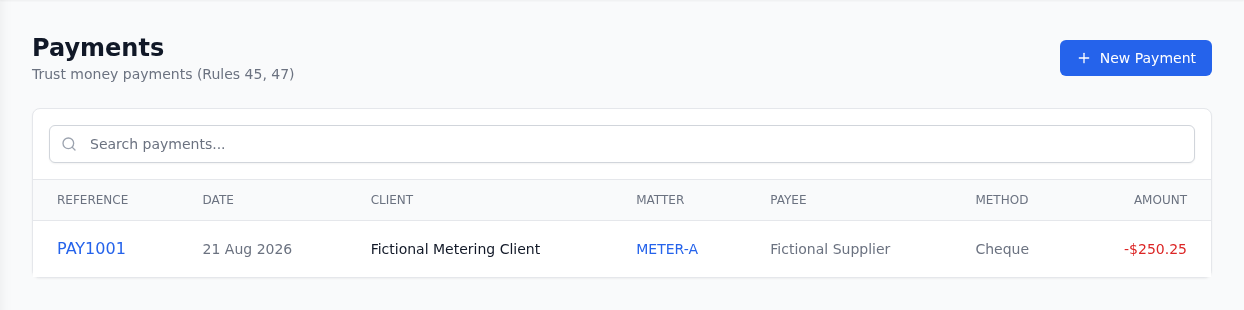
A payment records the payee, the method, the matter and the reason. For an electronic transfer, the form will not submit without the payee's account name, BSB and account number: the details Rule 47 requires you to have recorded, collected at the moment you would otherwise skip them.
A payment that would take the matter below zero is refused when you enter it. Not flagged at month end, when the money has already gone.
Rules 45 and 47
Payments
Every payment against its matter: reference, payee, method and amount. Fictional practice, invented figures.
Rule 46
Money moves between matters
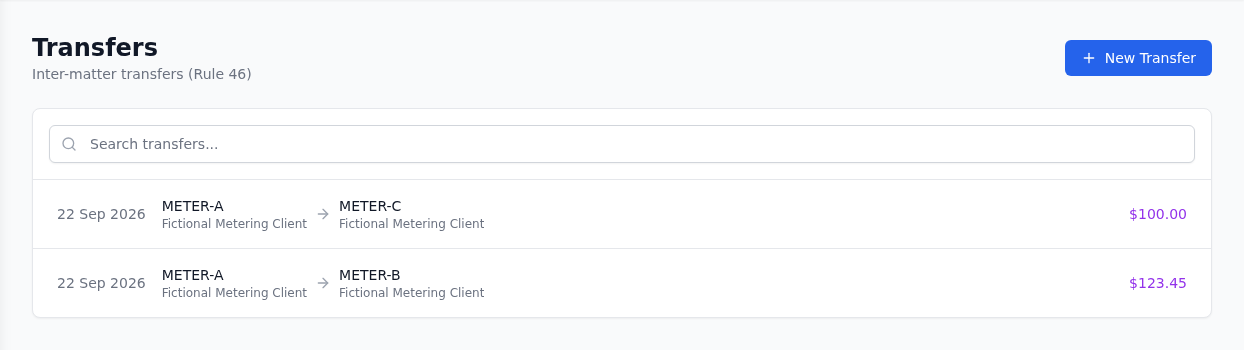
A transfer writes a journal entry against both ledgers, each side carrying a reference to the other, and takes a transfer reference of its own. It does not create a cash book entry, because nothing entered or left the trust account. That is the treatment the Rules require, and the one most spreadsheets get wrong.
Rule 46
Transfer journal
Every inter-matter transfer, both matters named, in sequence. Fictional practice, invented figures.
Rule 48
Month end
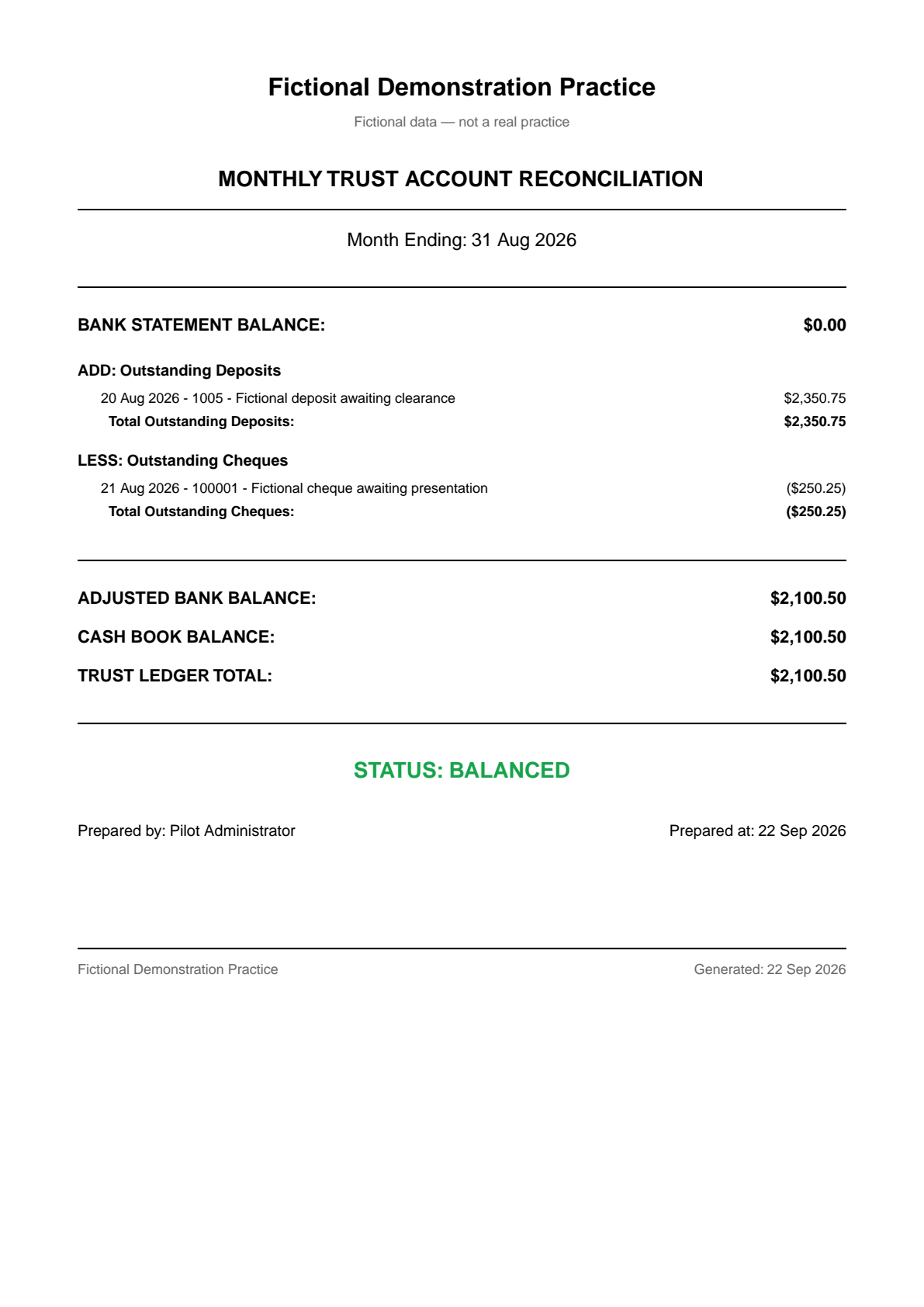
Enter the bank statement balance, itemise the deposits that have not cleared and the cheques that have not presented, and note any bank error. TrustLedger computes the cash book balance and the total of every ledger from the records themselves, reconciles the three, and tells you whether it balanced or by exactly how much it did not.
It produces the receipts cash book, the payments cash book, the ledger account list, the bank reconciliation statement and the trust trial balance. Once a month has a reconciliation against it, that month is closed to ordinary entry: a receipt or payment dated into it is refused. An administrator can still record a genuine late item, but only with a written reason that is kept against the entry.
Rule 48
Bank reconciliation
Outstanding deposits and unpresented cheques itemised, three balances that have to agree, and the result. Fictional practice, invented figures.
Rule 47
What the client sees
A matter statement shows every movement in date order with a running balance, and opening and closing figures for the period, as a PDF you can send.
You can also issue a client a link to their own matter's report. It records when it was last opened and how often, can be given an expiry when you issue it, and can be switched off at any time. Correspondence sent from the application is logged against the matter.
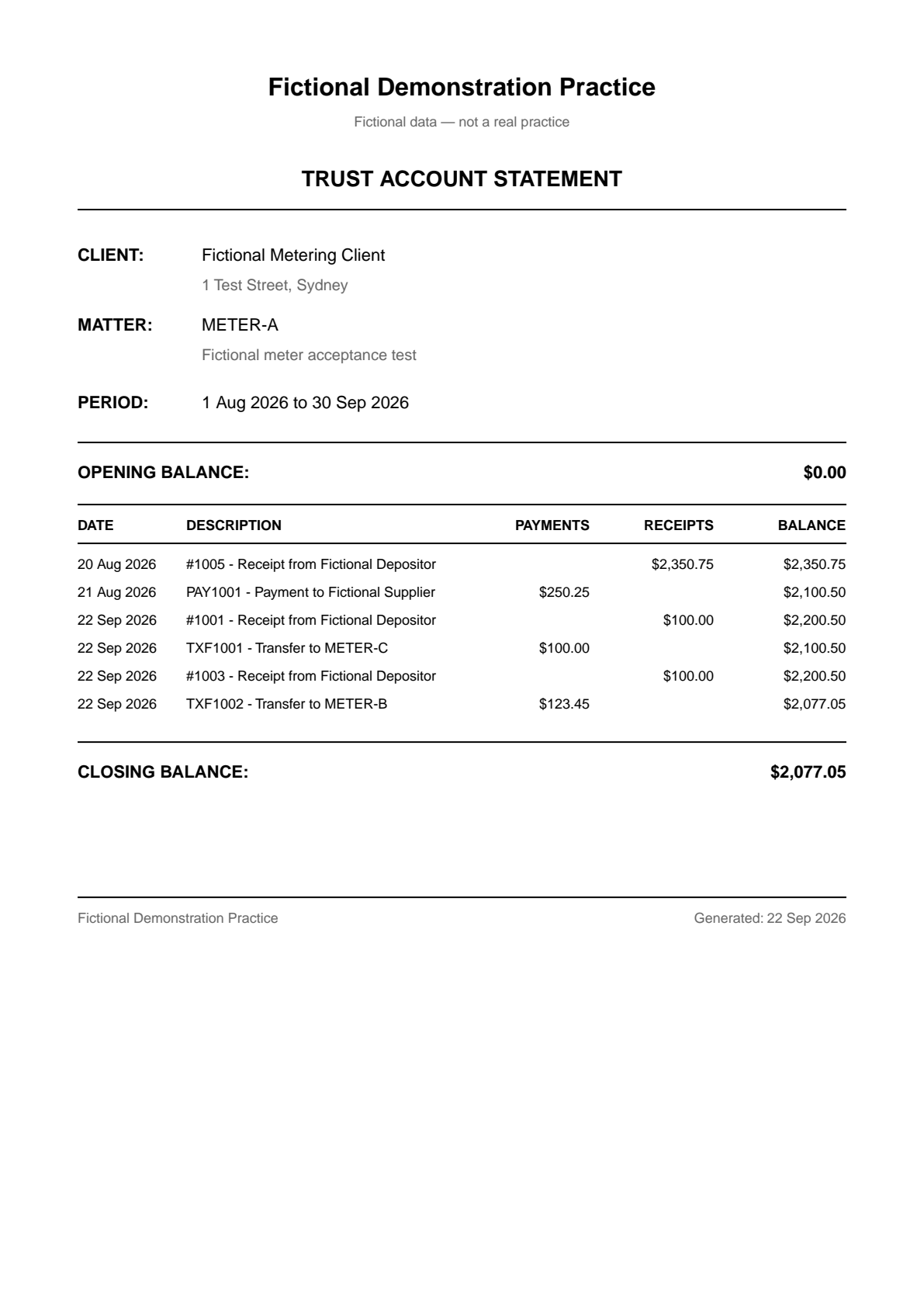
Rule 47
Trust ledger for a matter
One account per matter, every movement, running balance. Fictional practice, invented figures.
Asking for trust money
Send a client a request for trust money against a matter: the amount, the purpose and a due date. When a receipt for that matter and that amount is recorded, it settles the oldest matching request on its own. A part payment or a different amount leaves the request open for you to close by hand, which is the safer default.
Who did what
Every entry that moves money, whether a receipt, a payment, a transfer or a reconciliation, records who made it, when, from what address, and the state of the record before and after. So do user, role and settings changes. Users have roles, and the application enforces them from the database rather than from the browser.
Everything else is deliberately absent
TrustLedger holds no office account, produces no bills, stores no documents and records no time. A trust-accounting-only tool can be excellent at one statutory obligation in a way a suite with a trust module rarely is, and that is the whole argument for it. If you need practice management, you need practice management.