Legal Profession Uniform General Rules 2015 · NSW · VIC · WA
The trust account, done properly.
TrustLedger keeps the trust records the Uniform General Rules require of a law practice in New South Wales, Victoria or Western Australia: receipts, cash books, transfer journal, ledgers and the monthly reconciliation. Month end reconciles on screen. Your examiner gets a set of documents, not a login. And it does trust accounting only, so there is nothing to work around.
Built by a practising solicitor to run his own firm's trust account.
$25 per matter, including GST, charged once when you activate the matter. Your first two are free. How pricing works
Rule 48 · Bank reconciliation
Halloway & Finn · Month ending 31 March
Illustration
Balanced
The output
What your examiner gets
An external examination is a reading exercise. Someone sits down with your records and checks that they hold together. These are the four documents they start with, exactly as TrustLedger produces them, for a practice that does not exist.
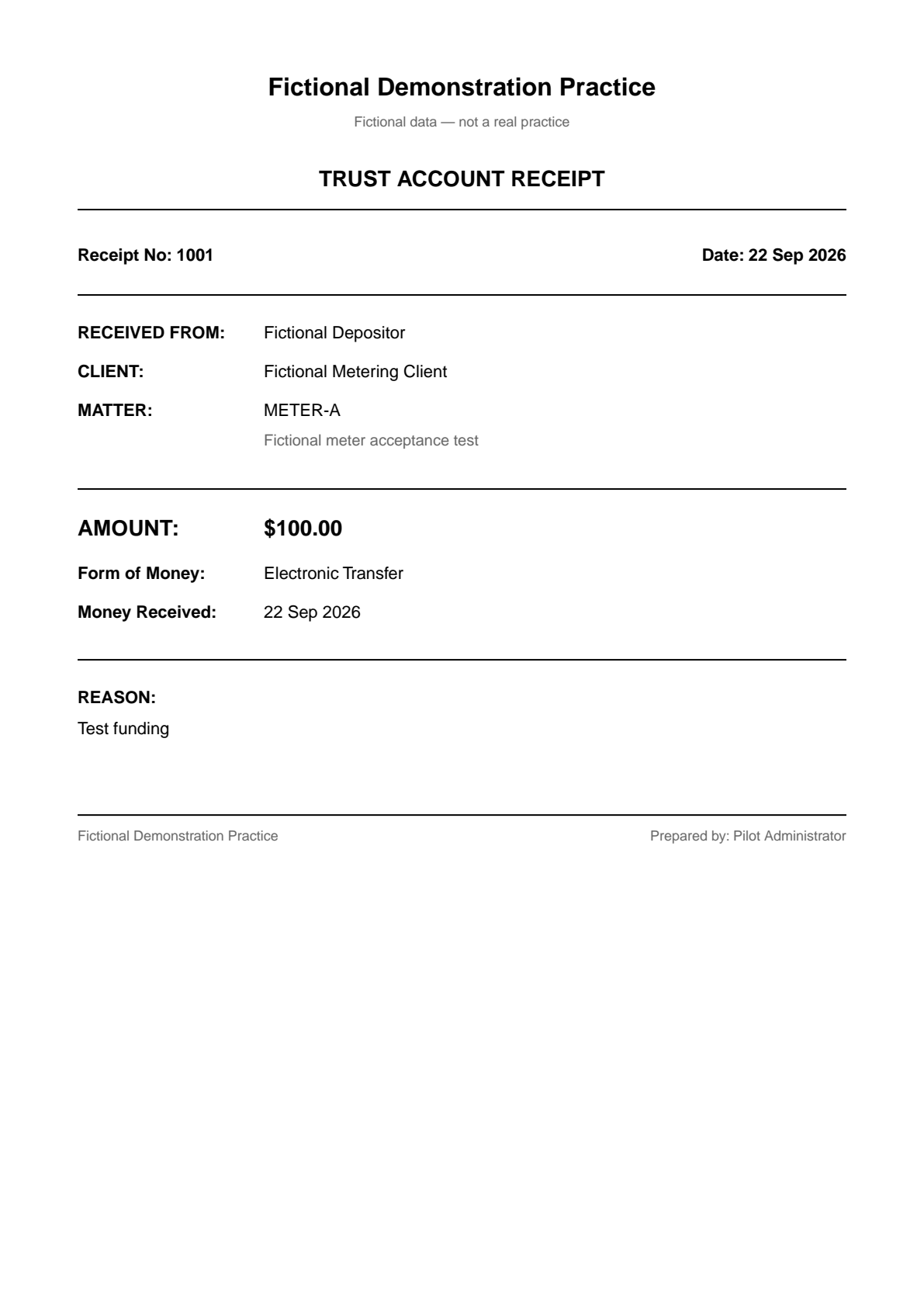
Rule 36
Trust receipt
Consecutively numbered. Who the money came from, which matter it belongs to, the form it arrived in and what it was for. The date it arrived and the date the receipt was issued are recorded separately, as Rule 36 asks.
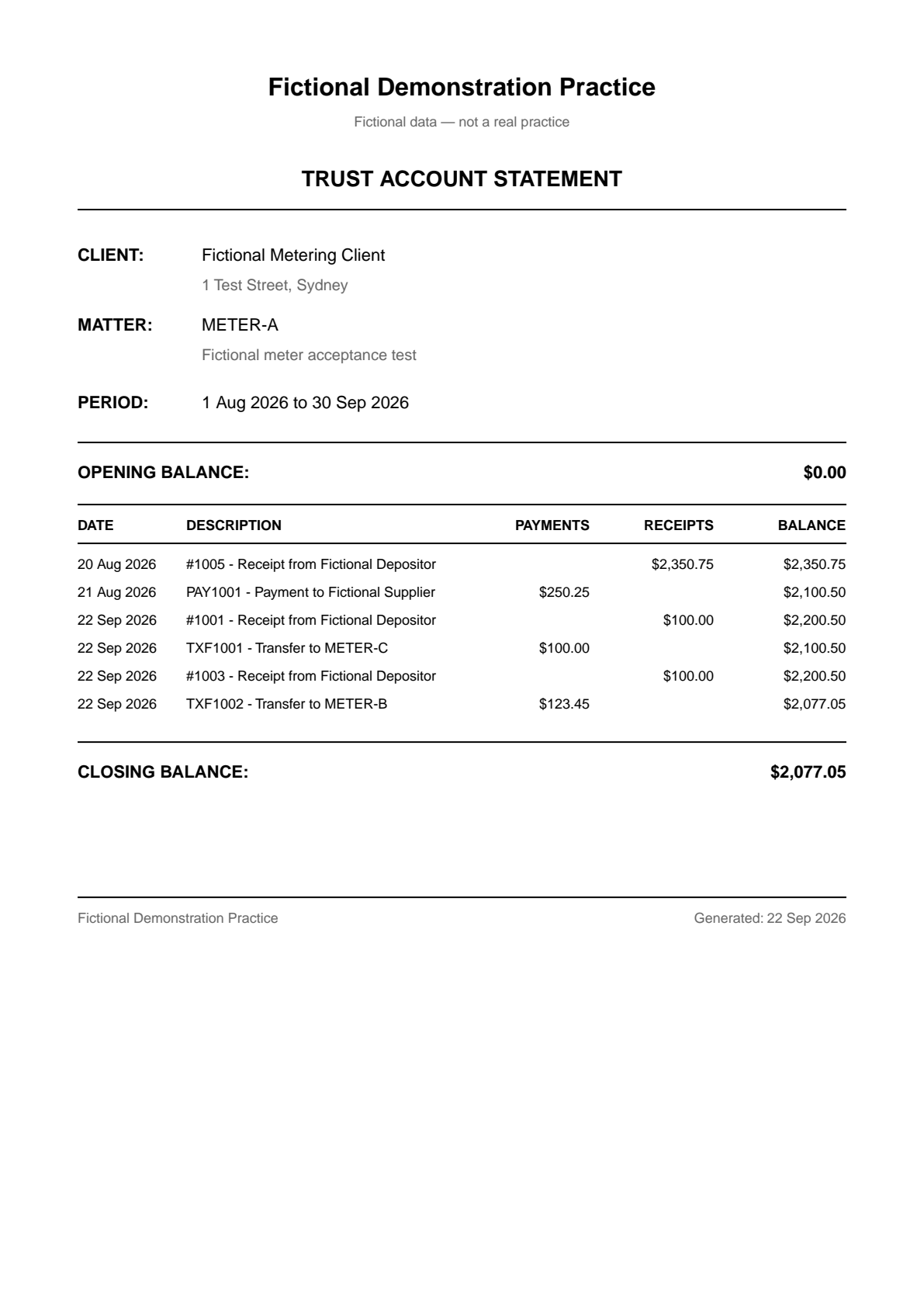
Rule 47
Trust ledger for a matter
One account per matter. Every movement in date order with a running balance, and opening and closing figures for the period. This is the statement you send the client.
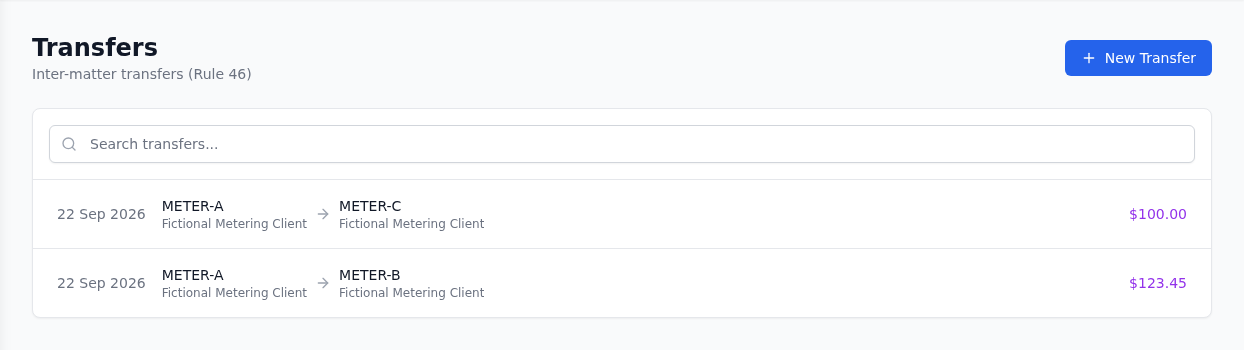
Rule 46
Transfer journal
Every transfer between matters, in sequence, with both matters named. No cash book entry, because no money left the account. That is the treatment Rule 46 requires.
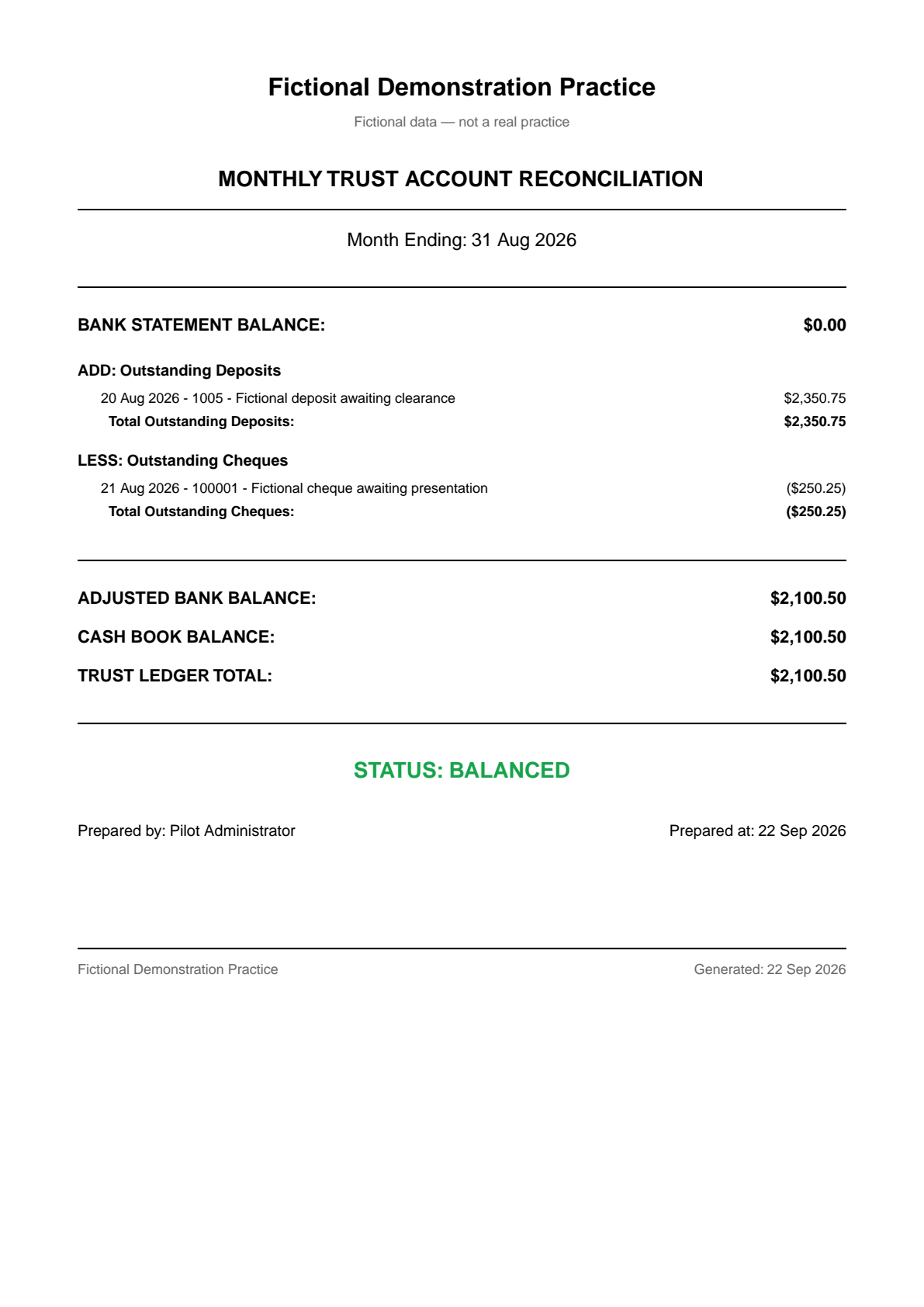
Rule 48
Monthly reconciliation
Bank statement to cash book to ledger totals. Outstanding deposits and unpresented cheques itemised, and the result stated at the bottom, where the examiner looks first.
Rule by rule
Six rules, and what happens to each
One instrument governs trust money in all three states: the Legal Profession Uniform General Rules 2015. Same rule numbers, same records, same trust year. Here is how TrustLedger handles each one.
- r 36 Receipting of trust money
- Consecutively numbered receipts. The date the money arrived and the date the receipt was issued are recorded separately, along with who it came from, the matter, the form it arrived in (cash, cheque, electronic transfer, direct debit) and what it was for.
- r 44 Trust account receipts cash book
- Every receipt writes its cash book entry in the same database transaction that creates the receipt. Either both exist or neither does. The month exports to XLSX or CSV.
- r 45 Trust account payments cash book
- Every payment writes its cash book entry the same way, recorded against the matter, the payee, the method and the reason.
- r 46 Trust account transfer journal
- A transfer between two matters is written as a journal entry on both ledgers, each side carrying a reference to the other. It never touches the cash book, because no money has entered or left the trust account.
- r 47 Recording transactions in trust ledger accounts
- One ledger account per matter, opened with the matter and carrying a running balance. An electronic payment will not submit without the payee's account name, BSB and account number.
- r 48 Reconciliation of trust records
- Bank statement to cash book to ledger totals, monthly, with outstanding deposits, unpresented cheques and bank errors itemised. Produces the bank reconciliation statement and the trust trial balance, and tells you whether it balanced or by exactly how much it did not.
Rules cited are those of the Legal Profession Uniform General Rules 2015, which apply in New South Wales, Victoria and Western Australia.
A matter cannot be overdrawn
A payment or transfer that would take a matter below zero is refused when you enter it, not discovered at month end.
Nothing is half-written
Receipt, ledger transaction, cash book entry and running balance move together in one database transaction, or none of them moves.
The ledgers can be checked from outside
A read-only checker walks every ledger and reports any account whose stored balance disagrees with its ledger read in date order, any account that does not close at the balance it holds, and any matter that was ever overdrawn.
From the author
I built this for my own trust account.
I am a solicitor, and I hold trust money. Once a year an external examiner goes through my trust records line by line, and if something in them is wrong, it is my name on it.
I went looking for software that did only this and did it properly. What I found was practice management suites with trust as one module among fifteen, priced per user, and spreadsheets that work until the year they do not. So I wrote the thing I wanted to hand over.
I wrote it to run my own firm's trust account, under the same Rules and the same annual examination you answer to. Every screen in it exists because I needed it at a month end, or because an examiner will ask for it.
It is one practice, not fifty. Yours will do something mine has never had to. Bring that to the walkthrough. Finding it early is the whole point of the call.
Richard Prangell Principal, Viridian Lawyers
Your records
They are yours, and they stay yours
Your own database
Each firm gets its own database with its own credentials, on infrastructure in Australia. Your ledger shares a table with nobody.
Exports you can hand over
Cash books, ledger lists, reconciliations and the trial balance export to XLSX or CSV. Receipts, payments and matter statements come out as PDF. Every one of them opens without TrustLedger.
We never delete your records
Trust records carry a seven-year retention obligation, and it is yours, not ours. Leaving ends new entries. It does not end the record, your access to it, or your examiner's.
The fair question to ask any small vendor is what happens if it stops. The answer is the export. Every cash book, ledger, reconciliation and statement comes out as a spreadsheet or a PDF, and you can take the full set whenever you like, including on your last day.
Price
One number
$25 per matter, including GST. Charged once, when you activate the matter.
No per-user fees. No monthly minimum. Your first two matters are free.
A matter that never holds trust money is never charged. Most files in most practices never touch the trust account. Those cost nothing.
The charge never repeats. A conveyance that runs eight months costs the same as one that settles in three weeks.
Every charge is recorded against the matter it was for. The fee report lists each activated matter and what was paid, kept entirely apart from your trust records. Whether you pass it on under your retainer is your call, not ours.
$150.00
for those matters, including GST
Charged once. Those matters are never charged again, so next month's figure covers next month's new matters only. Your first two matters are free, once, and are left out of this estimate.
Pricing in full, including what happens to your records if you leave.
Who is behind it
Built inside a law firm, not a software company.
TrustLedger comes from Viridian Lawyers Pty Ltd, a Sydney law practice, and was written by the solicitor who needed it. There is no sales team. Your enquiry lands with the person who wrote the software, and a walkthrough is a screen share with him.
- Author
- Richard Prangell
- Role
- Principal, Viridian Lawyers
- Entity
- Viridian Lawyers Pty Ltd
- ABN
- 81 603 176 781